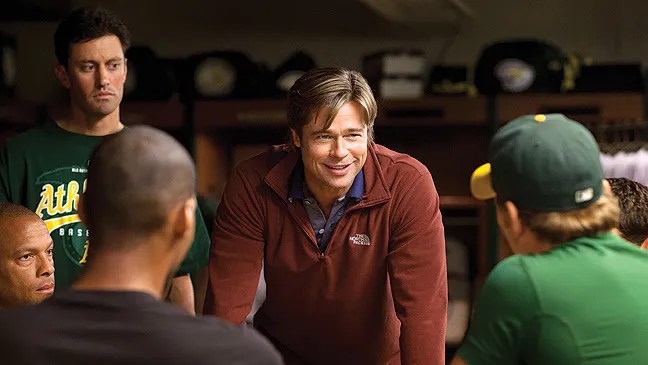
Over two decades ago, Billy Beane and the Oakland Athletics (A’s) birthed Moneyball and launched the era of sabermetrics. Within the context of the A’s, Moneyball referred to building a competitive baseball team with a small budget. Moneyball was integral to the evolution and competitive landscape of baseball because baseball differs from other sports since it does not feature a salary cap. This means that there are Goliaths (ie. New York Yankees and Mets, Boston Red Sox, Los Angeles Dodgers) and there are Davids (ie. Oakland A’s, Tampa Bay Rays, Miami Marlins) year after year in terms of how much money teams have to spend.
Last weekend, I decided it would be a good idea to rewatch ‘Moneyball’ for inspiration on an article introducing the profound impact of data in baseball. I really enjoyed the movie, and it reminded me of my childhood dream of one day becoming a General Manager of a MLB sports franchise. Now, you cannot watch baseball without statistical analysis or sabermetrics being mentioned. I mean, there are entire shows on MLB Network (looking at you ‘MLB Now’) whose main focus is what do the numbers really say about a given team or player.
However, after I rewatched the movie, I began to wonder, ‘Is Moneyball still applicable in the modern game?’, especially with every team by now adopting some degree of analytical or sabermetric approach to team building. In this article, I hope to answer that question by diving into small market baseball teams with a limited budget, and grading their success over the last 20 years.
Context
According to Fangraphs, the six teams with the lowest payroll are (in order of highest to lowest): the Tampa Bay Rays, Miami Marlins, Baltimore Orioles, Cleveland Guardians, Pittsburgh Pirates, and the Oakland A’s. Each of these teams have seen highs and lows over the past couple decades, however what makes these teams different is the fact that their competitive windows are often much (much) shorter than other teams. This is for a myriad of reasons, most notably because they do not have the capital to retain quality championship-level players when they hit free agency. This means that they need to be able to capitalize on successful seasons much more than teams like the Yankees or Dodgers who know they are going to continue spending and can attract and retain talent.
| Top Six Largest Payrolls (2024) | ||||||
| Team | 2024 Projected Payroll | Record (since 2000) | Win % (since 2000) | Record (since 2015) | Win % (since 2015) | Made Playoffs (since 2015) |
| New York Mets | $315 Million | 1887-1897 | 49.9% | 689-667 | 50.8% | 3/9 years |
| Los Angeles Dodgers | $302 Million | 2141-1645 | 56.6% | 845-512 | 62.3% | 9/9 years |
| New York Yankees | $296 Million | 2192-1590 | 58.0% | 771-585 | 56.9% | 7/9 years |
| Philadelphia Phillies | $245 Million | 1924-1861 | 50.8% | 648-708 | 47.8% | 2/9 years |
| Houston Astros | $240 Million | 1941-1844 | 51.3% | 801-555 | 59.1% | 8/9 years |
| Toronto Blue Jays | $236 Million | 1903-1882 | 50.3% | 702-654 | 51.8% | 5/9 years |
| Bottom Six Payrolls (2024) | ||||||
| Team | 2024 Projected Payroll | Record (since 2000) | Win % (since 2000) | Record (since 2015) | Win % (since 2015) | Made Playoffs (since 2015) |
| Tampa Bay Rays | $98 Million | 1879-1916 | 49.7% | 739-617 | 54.5% | 5/9 years |
| Miami Marlins | $97 Million | 1769-2013 | 46.8% | 598-756 | 44.2% | 2/9 years |
| Baltimore Orioles | $96 Million | 1714-2070 | 45.3% | 607-749 | 44.8% | 2/9 years |
| Cleveland Guardians/Indians | $96 Million | 1954-1830 | 51.6% | 744-610 | 54.9% | 5/9 years |
| Pittsburgh Pirates | $81 Million | 1691-2090 | 44.7% | 620-734 | 45.8% | 1/9 years |
| Oakland A’s | $59 Million | 1961-1823 | 51.8% | 638-718 | 47.1% | 3/9 years |
The team that exemplified this idea most were the 2014-2015 Kansas City Royals. During these two seasons, the Royals (who actually have the worst record in the MLB since 2000 and a bottom-10 payroll) made the World Series twice, winning against the Mets in 2015. For two years, the Royals were the team of baseball, possessing a plethora of young all-stars and a revolutionary approach to the game. However, that success was short-lived, as just as the window opened, it was shut and glued over. In the aftermath of the World Series season, their young core contributors were entering free-agency, and the Royals could only commit money to one or two players. Eric Hosmer left for San Diego and Lorenzo Cain to Milwaukee, and just like that, the Royals were left with Aaron Gordon (arguably the least valuable of their free agents) and Salvador Perez (who is the only remnant of the championship team today). Across two decades of mostly bad baseball, the Royals seized their short championship window, and luckily came home with a World Series trophy to show for it.
Regression Analysis
Before evaluating the teams, I decided to run a regression analysis of 2024 Projected Payroll (millions) and Win % (since 2015), to see if there was any evidence of a correlation between the two using Tableau’s visualization tools. The data points in green represent the top 6 largest payrolls, and the data points in red represent are the bottom 6 payrolls.

With a p-value (probability that any observed difference between groups is due to chance) < 0.001 and an r-squared value (how well the regression approximates the actual data) = 33.59%, we can draw multiple conclusions.
- P < 0.001 means that we can be reasonably sure that payroll does have an effect on winning %.
- R-squared = 33.59% means that the model is not very good at making accurate predictions because there is a great amount of unexplained variance (other predictor variables needed)
This ultimately leaves us with a slightly positive correlation between the two variables, however, as the r-squared suggests, the uncertainty of a baseball season (ie. injuries, suspensions, the unpredictable nature of baseball) and other inputs that affect a team’s success other than money (ie. player development, coaching, a weak division) implies that payroll does not destine a team to a certain level of success or failure and that there are other variables involved.
Tampa Bay Rays
We start the team evaluations on a high note with the Tampa Bay Rays. Arguably, the Rays are the most Moneyball-like team in the MLB, finding value in undervalued players and then revitalizing their potential to flip for profit or ball-club success. Despite rarely signing any notable free agents (besides resigning from within), the Rays consistently put out a competitive team on the field and compete in the gauntlet known as the AL East.
Trades, no matter how small, big, insignificant or lopsided against the Rays favor, almost always seem to benefit the team and have fueled the team’s consistent competitiveness, and much of the credit belongs to their commitment to player development and sabermetrics. For years, they have sought for older prospects and post-hype players looking to reinvigorate their career. Due to their low payroll, the Rays are forced to get creative in order to churn the roster while keeping short- and long-term outlooks in mind. Here’s a list of some notable trades by the Rays:
- 2018: Rays trade RHP Chris Archer to the Pittsburgh Pirates for OF Austin Meadows, RHP Tyler Glasnow and RHP Shane Baz
- 2019: Rays trade 1B Jake Bauers to the Cleveland Indians for INF Yandy Diaz and RHP Cole Sulser
- 2019: Rays trade 2B Nick Solak to the Texas Rangers for RHP Pete Fairbanks
- 2020: Rays trade LHP Matt Liberatore and C Edgardo Rodriguez (+pick) to the St. Louis Cardinals for OF Randy Arozarena, OF/1B Jose Martinez (+pick)
- 2022: Rays trade OF Austin Meadows to the Detroit Tigers for UTIL Isaac Parades
The Rays made the World Series in both 2008 and 2020, and lost both times to teams in the top-6 of baseball payroll. Since 2015, the Rays have the fifth best record in all of baseball.
Miami Marlins
The Miami Marlins might have the weirdest franchise history in baseball, and their historically low payroll definitely has a say in it. Since becoming an expansion team in 1993 (originally called the Florida Marlins), the Marlins have boasted one of the worst records in baseball. However, despite many teams that join them at the bottom of that list, they still have not one, but two World Series to show for it. Winning in both 1997 and 2003, the formula for Marlins success became quite clear: rely on an oversaturated farm system to hunt for a World Series in the short window before these stars would hit free-agency. The fact that it worked twice is still one of the biggest anomalies of baseball history.
However, immediately after both World Series, a complete fire-sale would ensue, and big-name players like a young Miguel Cabrera, Hanley Ramirez and Josh Beckett would not resign with the Marlins. When the farm system is not considered elite, the Marlins are a bottom half baseball team, sporting poor attendance in the process. The Marlins looked to have some momentum in the later-half of the 2010’s, however the tragic death of ace Jose Fernandez was the trigger that spurred a drastic rebuild, trading away their entire All-Star and MVP riddled outfield of Giancarlo Stanton, Christian Yelich and Marcell Ozuna.
Baltimore Orioles
Before their resurgence last season, the Baltimore Orioles spent a decade as perpetual losers. With an albatross contract to slugger Chris Davis and little to no farm system to speak of after their playoff stints in the mid-2010’s, the Orioles were basement dwellers in the loaded AL East.
Their strategy was quite simple to regain relevance: be bad, acquire top draft picks, and wait for them to develop. This approach, I argue, is not Moneyball, as they were not finding value where others didn’t, they just picked talented players with the high draft picks. This long-term strategy seems to have finally come to fruition, winning over 100 games last season and making the playoffs for the first time since 2016. Young phenoms like C Adley Rutschman, 1B Ryan Mountcastle, SS Gunner Henderson, consistent above-average outfielders like Cedric Mullins and Anthony Santander and a fierce bullpen catapulted the O’s to the top of the standings and breathed back excitement into Camden Yards. This success comes while the O’s possess the top farm system in the MLB, so more quality reinforcements are to expected to come (credit to the O’s commitment to player development).
Now with new ownership, maybe the O’s way of being a low-payroll team will dissipate. If that is the case, the rest of MLB must watch out.
Cleveland Guardians
When first researching these small market teams, I thought the Rays would have been the most successful in recent history. However, the Cleveland Guardians (formerly known as the Indians) are right up there with them. With consistently good coaching (so long Terry Francona), above-average pitching, and being the beneficiaries of the weakest division in baseball, the Guardians have been the model of consistency across baseball despite their anemic payroll. They were one game away from winning a World Series back in 2016, and despite a regression from their dominance since, they still put out a winning team year after year. Home-grown talent like Jose Ramirez keeps the offense relevant, while a competent pitching staff of Shane Bieber, Tanner Bibbee, Logan Allen and Tristan McKenzie keep the Guardians in most games.
Since 2015, the Guardians have the fourth best record in baseball.
Pittsburgh Pirates
The Pirates are trying to do what the Orioles did. Both were last relevant in the mid-2010’s, and have since been trying to build a haul of young talented players to make a push for the playoffs. However, unlike the O’s, success has not come yet. Yes, it is true that some have reason to be excited about the Pirates this year, with young potential stars in SS Oneil Cruz and RHP Mitch Keller, and their one quality player through all of this, OF Bryan Reynolds. Yet, the way in which they compiled this team lacks the effort and intense player development compared to the Orioles.
They rarely sign free-agents nor make any smart/creative trades like the Rays (in fact, they were the victims of the Chris Archer deal mentioned earlier). However, with a top-10 farm system, maybe they are a year or two or three away from being the next Orioles.
Oakland A’s
Last but not least (or maybe least considering the context of the club), we have the pioneers of the Moneyball movement, the Oakland A’s. While the A’s sport the best winning percentage of all six of these clubs since 2000, partially because Moneyball was still in its infancy in the 2000’s, the recent numbers depict a different and more depressing reality. Simply put, the A’s are horrible. They essentially had a Triple-A roster during the 2023 season and have the worst farm system according to The Athletic. Not to mention, constant talks of relocation and/or stadium negotiations have soured this once fun and exciting franchise. It was not long ago when the A’s made the playoffs, with young and fun players like Matt Chapman, Matt Olson and Sean Murphy, now seeing greener pastures with competitive teams.
I am convinced it will be a long, long time until the A’s are relevant in baseball again for their own-the-field play. Unlike most of the aforementioned teams with some remnants of a farm system to lean on during rough times, the A’s seem destined to possess the title as the worst team in baseball for the foreseeable future. With Moneyball no longer a secret tactic and analytics being adopted across the league, the A’s no longer have their niche competitive advantage. They have nothing, unless an influx of cash comes in the near future.
Conclusion
“Is Moneyball Dead?” That is a hard question to answer. Moneyball was founded on the idea of scrapping for every last dollar to compile undervalued players who ultimately got on base, scored runs and prevented the other team from scoring runs. Teams like the Rays and Guardians have done this successfully, putting out consistently successful teams in spite of frugal ownership. However, I would give more credit to those team’s player development and team’s culture of winning.
Yet, this Moneyball approach is no longer unique. All 30 MLB teams took note of Billy Beane’s innovative and purely analytical strategy, and have incorporated it in their team building approach. Data is more easily accessible across the league, meaning it is really difficult for one team to take advantage of the strategy. Imitation has made Moneyball forever a part of baseball, however, the competitive strategy of the approach is lost since every team is doing it. So, I would argue that Moneyball as a foundational framework of player evaluation and roster construction is alive and will continue to thrive, but Moneyball as a competitive strategy for small-market ball clubs to compete diminishes as data and analytics become more mainstream season after season.
Work Cited
Champs or Chumps (n.d.) Most MLB wins since 2000. Retrieved Feb. 21, 2024, from
https://champsorchumps.us/records/most-mlb-wins-since-2000
Champs or Chumps (n.d.) Most MLB wins since 2015. Retrieved Feb. 21, 2024, from
https://champsorchumps.us/records/most-mlb-wins-since-2015
Fan Graphs (n.d.). Payroll breakdown. Retrieved Feb. 21, 2024, from
https://www.fangraphs.com/roster-resource/breakdowns/payroll
Law, Keith (2024, February 9). MLB 2024 farm system rankings: Keith Law ranks all 30 teams, Orioles are new No. 1. The Athletic. Retrieved Feb. 21, 2024, from
https://theathletic.com/5258158/2024/02/09/mlb-farm-system-rankings-2024
Trezza, Joe. (2021, December 1). The 10 biggest trades in Rays history. Mlb.com. Retrieved Feb. 21, 2024, from
https://www.mlb.com/news/10-biggest-trades-in-rays-history-c301004520




Leave a Reply