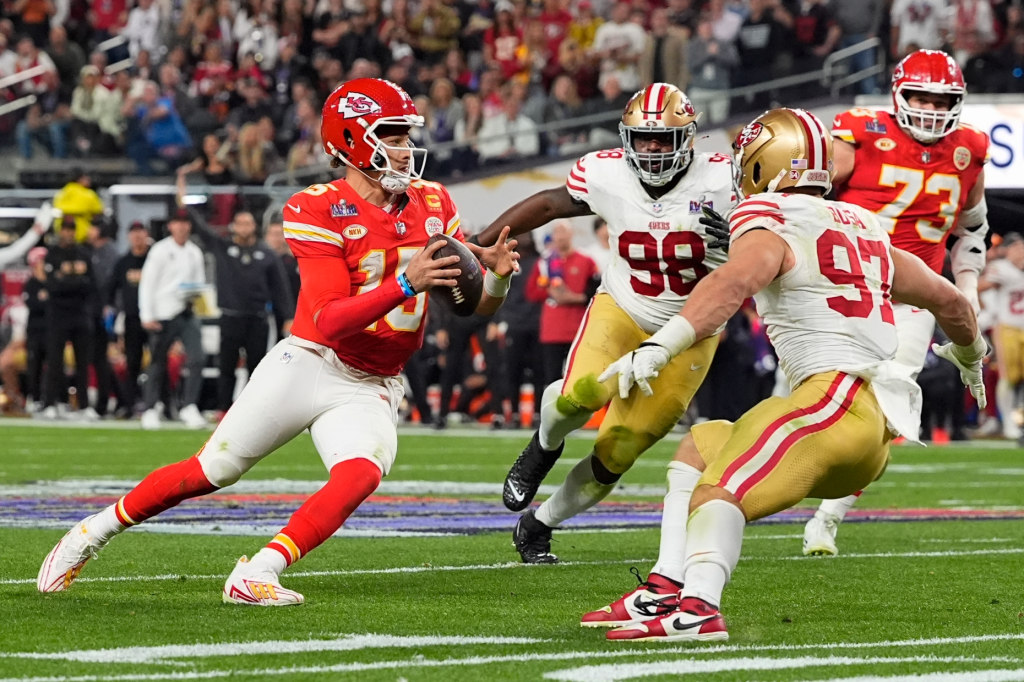
Face-to-face with the potential dynasty-building quarterback, Patrick Mahomes, All-Pro Linebacker Fred Warner uttered the words, ‘We Want the Ball’ when the coin toss to open overtime in the Super Bowl landed in the San Francisco 49ers’ favor. Despite the immediate enthusiasm of receiving the ball first, then taking over seven minutes of the clock to march down to the Chiefs red zone just to kick a field goal on fourth down, the Kansas City Chiefs would respond with a commanding drive, taking up the rest of the clock and punching their third Super Bowl in the last four years with an easy 3-yard reception to wide receiver Mecole Hardman Jr.
And with that, the Chiefs birthed a dynasty, Travis Kelce and Taylor Swift embraced on the field (which is what probably half of those watching were really rooting for) and over 80% of those who had bet on the spread/moneyline left with extra money in their pocket. However, in its aftermath, all anyone is talking about are the playoff overtime rule changes enacted before the season and the 49ers’ decision to receive the ball when winning the coin toss.
Before I take a deep dive into the rule changes and overtime strategies, I want to make it clear that I do not think that these four words ‘lost’ the 49ers the game. They had the opportunity to end the game if they held the Chiefs on fourth-down in overtime, not to mention a couple mistakes on special teams – a missed extra point and fumble on a punt – that made it possible for the Chiefs to tie the game and force overtime. However, what I am saying is that not fully understanding the new playoff overtime rules and their implications of the coin-toss decision had put the 49ers in a more difficult spot to win the game in the end.
History and Build Up to Rule Change
For most of football’s history, overtime rules functioned like sudden death, the first team to score any points won the game. The winner of a coin flip would decide whether they wanted to kick or receive the ball first, to which all teams would choose the ball first to deny the opponent a chance of winning.
However in 2010, the rules would change for the first time. In the playoffs, the first team with possession can only end the game with a touchdown, meaning that if they kicked a field goal, then the other team had the opportunity to match it or score a touchdown. This rule would later extend to all games in 2012, and remained the status quo for about a decade.
Then in 2019, controversies over overtime emerged once again in the playoffs, when the New England Patriots and Chiefs found their way into overtime in the AFC Championship. The Patriots won the toss and ultimately scored a touchdown to end the game without giving the Chiefs a chance to fight. Subsequently, many in the Chiefs organization called out the overtime rules in the playoffs, pitching that both teams should get the opportunity to possess the ball at least once, even if the first team scored a touchdown. The rhetoric would resurface again after the 2022 AFC Championship between the Buffalo Bills and Chiefs, where in ironic fashion, the Chiefs benefited from the rules they initially complained about and scored a touchdown on their first possession, denying the Bills of a chance to retaliate.
The NFL could not sit quietly and ignore the power of a coin flip (the one event in football that is outside of anyone’s control). Over the previous decade with these overtime rules, the team that won the coin toss in the playoffs were 10-1 (with the lone loss coming from the Saints in 2018 against the Rams) and 7 of the 10 won with an opening drive touchdown (Camenker, 2022). Therefore, before the 2023 season, the NFL amended its playoff overtime rules, now eliminating sudden death in all scenarios and guaranteeing each team a possession. If the first team scored a touchdown, now the second team had one possession to match the touchdown or potentially take the lead with a successful two-point conversion. The team with the ball second would also not be restricted by the clock, as a second overtime period would start if the team was still in the middle of their first possession. If the score was tied after each team possessed the ball once, then the next team to score wins.
Up until the Super Bowl, these rules had not been activated yet as no playoff games went into overtime. Leave it to the biggest game of the year to demonstrate unprecedented rule changes and confuse everyone watching and involved.
Was the 49ers’ decision wrong?
This answer is not as black and white as the media makes it seem, especially when there has been no precedent set before.
The ball was in the 49ers’ hands after winning the coin toss, both literally and figuratively. They had the choice of choosing the more advantageous position in the most pivotal time of the season. Unfortunately, according to statements from 49ers players and staff post-game, it appears that many were unaware of the implications of the rule changes and therefore were unprepared in their decision making at this critical point of the game. On the other hand, there have been reports that the Chiefs discussed the new rules and format in great detail over the offseason and were immensely prepared if the situation arose.
Many claim that electing to kick provides the kicking team with one clear advantage: they get to see what their opponent is able to do with their first drive and know exactly what they have to do to keep the game going or to win. We have seen precedent for this strategy in the NCAA’s overtime format, where teams more often elect to possess the ball second, to get a better sense of what is needed for their drive. However, that advantage only lasts every other overtime, as a tied game after both teams possess the ball forces another overtime with the order flipped (the order keeps alternating until a winner is decided). The evidence for this strategy is favorable in the NCAA, but not so strong as a paper in Frontiers in Artificial Intelligence found that the team electing to defend first won 51.03% of games from 2013-2019 (Wilson, 2020). Despite the slightly favorable decision to elect to defend first in the NCAA, because of an incongruence in overtime rules, it would be difficult to directly translate this data to the NFL.
On the other hand, statements from 49ers’ coach Mike Shannahan paint a picture on the ball-first strategy. He claimed that the analytics showed that getting the ball third was most advantageous, hoping that after two possessions, the game would be tied and in their hands. However, if we want to take All-Pro Defensive End Chris Jones’ claims after the game to heart, that strategy would have been futile, as he said that their strategy if they won the coin toss was to “give the ball to the opponent” and “if we scored, go for two” (2024). This would have meant regardless of the outcome of the 49ers drive (unless they went for the two-point conversion after a touchdown), the Chiefs were not going to give the 49ers an additional drive.
With this overtime featuring unprecedented rules and format and the 49ers failing to win the game, it is easy to blame the loss on a simple coin toss and subsequent decision. If the 49ers had won, I am sure the media would not be preaching this narrative that the 49ers were unprepared and the ball-first strategy is the bad decision. Hindsight is 20-20, and I hope that with more seasons with this rule underneath its belt, the data will accumulate and provide more accurate analytics to aid in the coin-toss decision.
Work Cited
49ers decision in overtime questioned after Chiefs score decisive touchdown. (2024, February 12). NBC News. Retrieved Feb. 13, 2024, from
Camenker, Jacob. (2022, January 25). NFL overtime rules: A timeline of every failed NFL team proposal to change OT format since 2010. The Sporting News. Retrieved Feb. 13, 2024, from
https://www.sportingnews.com/us/nfl/news/nfl-overtime-rules-change-history/6pvqnjap550d1hkwrth6mphww
Wilson, Rick L. (2020, August 26). College football overtime outcomes: Implications for in-game decision making. Frontiers in Artificial Intelligence, vol. 3. Retrieved Feb. 13, 2024, from

 It's a Numbers Game
Leave a comment